
Seed to City: A Circular Bioeconomy Framework for Industrial Hemp and Construction in New York State
Seed to City: A Circular Bioeconomy Framework for Industrial Hemp and Construction in New York State
Researchers at CASE are developing a spatial decision-making framework for building circular bioeconomy systems around emerging bio-based materials, using industrial hemp and the New York State construction industry as a primary case study. The central challenge the project addresses is methodological: existing supply chain optimization tools perform well within established networks but offer little guidance when the infrastructure itself does not yet exist. This framework fills that gap, providing a rigorous and replicable approach to planning a local biomaterial economy from the ground up.
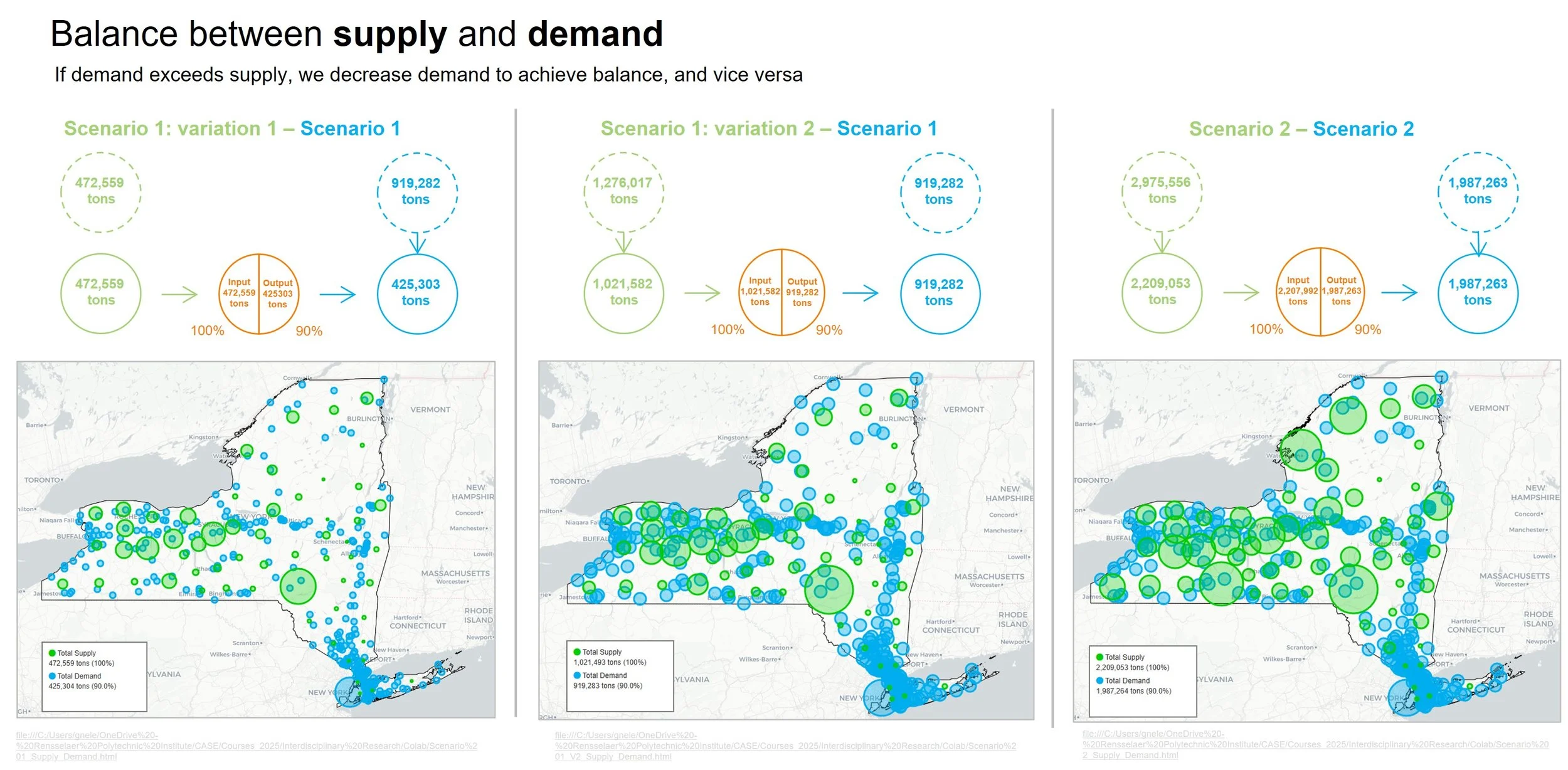
The framework operates across the full supply chain. On the supply side, USDA Census of Agriculture data is used to map existing cropland across NYS counties and model hemp cultivation scenarios through strategic densification of row crops and selective rotation with hay and pasture. Depending on the approach, between 170,000 and 1.1 million acres of land become available for hemp cultivation, yielding between 780,000 and 5 million tons of fiber and hurd annually. On the demand side, material requirements are quantified for three hemp-derived construction products including hemp wool insulation, hempcrete, and Hemp Retrofit Siding (HeRS), and matched against NYSERDA building stock data to calculate annual envelope demand across NYS residential building types. A baseline scenario driven by new construction requires approximately 190,000 tons of raw material per year. An accelerated scenario calibrated to the pace of retrofit needed to address the 74% of NYS residential buildings constructed before 1980 raises that figure to 411,000 tons, a threshold that aligns with New York State's 2050 building decarbonization goals.
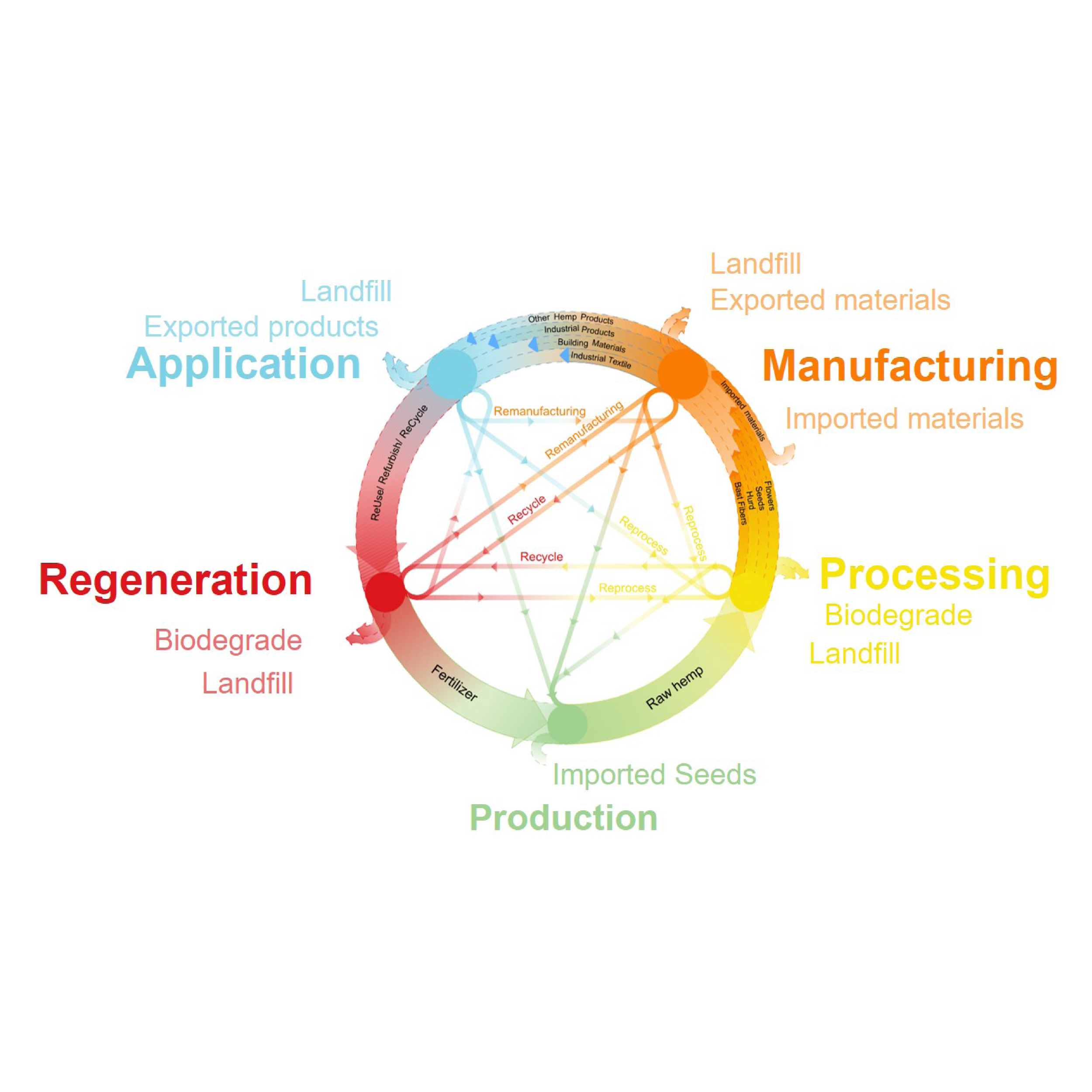
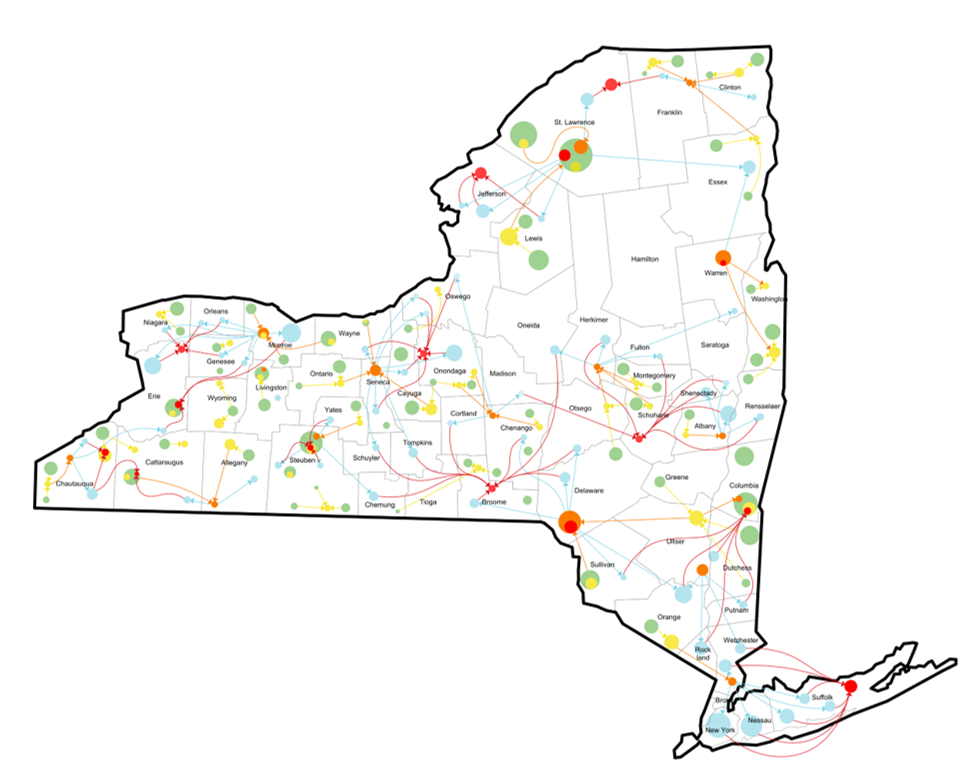
With supply and demand geolocated at the county level, the framework models the intermediate stages linking them: processing, manufacturing, construction, and end-of-life regeneration. Facility siting is evaluated using both K-means clustering and Mixed-Integer Linear Programming (MILP), allowing comparison between configurations that minimize transport distance and those that distribute economic activity more equitably. The latter approach accounts for job creation, regional development priorities, and the reality that such systems will not be built at once but will require phased investment over time. Across all modeled scenarios, NYS cropland capacity exceeds current construction demand, pointing to export potential and opportunities to supply neighboring markets. The total addressable market for hemp-based building products within NYS is estimated at $3.6 billion annually, and the framework is implemented as an interactive geospatial tool that allows public and private stakeholders to explore scenarios, adjust product mix assumptions, and evaluate infrastructure investment strategies at the county level.
Project Date: 2024-Present
Researchers: Alexandros Tsamis, Gnel Yeghiazaryan
Collaborators: